This is an updated version of what I have posted. I am still learning more and more about the Guadalcanal Campaign. I had found more information about it and I want to share it…
Excerpt (see below for the whole story)
The dedicated personnel of CUB One performed these feats for 12 days before Marine squadron ground crews arrived with the proper equipment to service the aircraft. The crucial support provided by CUB One was instrumental to the success of the “Cactus Air Force” on Guadalcanal.
ORIGINAL POST

I have to admit I have had a hard time explaining why there were wrong information in that book.
Reading yet another chapter of Feux du ciel led me to search one incident that happened on the day before the ambush on Admiral Yamamoto.
Supposedly there was a raid on Henderson Field and Corsairs took off to intercept. Clostermann described how one Corsair pilot was shot down and was trapped in his burning plane when he crashed…and someone had to shot him because they could not save him.Further reading found Clostermann talking about Yamamoto being aboard a Sally not a Betty. This is how I finally ended up visiting this Website…https://www.nps.gov/parkhistory/online_books/npswapa/extcontent/usmc/pcn-190-003122-00/index.htm
And on YouTube visiting Henderson Field…
Better resolution…
I am so glad I have read Feux du ciel once again 55 years later.
UPDATE
Closely reading about Time of the Aces: Marine Pilots in the Solomons, this is what I had found worth sharing.
‘CUB One’ at Guadalcanal
On 8 August 1942, U.S. Marines captured a nearly completed enemy airstrip on Guadalcanal, which would prove critical to the success of the island campaign. It was essential that the airstrip become operational as quickly as possible, not only to contest enemy aircraft in the skies over Guadalcanal, but also to ensure that badly needed supplies could be flown in and wounded Marines flown out.
As it turned out, Henderson Field also proved to be a safe haven for Navy planes whose carriers had been sunk or badly damaged. A Marine fighter squadron (VMF-223) and a Marine dive bomber squadron (VMSB-232) were expected to arrive on Guadalcanal around 16 August.
Unfortunately, Marine aviation ground crews scheduled to accompany the two squadrons to Guadalcanal were still in Hawaii, and would not arrive on the island for nearly two weeks. Aircraft ground crews were urgently needed to service the two Marine squadrons upon their arrival.
The nearest aircraft ground crews to Guadalcanal were not Marines, but 450 Navy personnel of a unit known as CUB One, an advanced base unit consisting of the personnel and material necessary for the establishment of a medium-sized advanced fuel and supply base. CUB One had only recently arrived at Espiritu Santo in the New Hebrides.
On 13 August, Admiral John S. McCain ordered Marine Major Charles H. “Fog” Hayes, executive officer of Marine Observation Squadron 251, to proceed to Guadalcanal with 120 men of CUB One to assist Marine engineers in completing the airfield (recently named Henderson Field in honor of a Marine pilot killed in the Battle of Midway), and to serve as ground crews for the Marine fighters and dive bombers scheduled to arrive within a few days.
Navy Ensign George W. Polk was in command of the 120-man unit, and was briefed by Major Hayes concerning the unit’s critical mission. (After the war, Polk became a noted newsman for the Columbia Broadcasting System, and was murdered by terrorists during the Greek Civil War. A prestigious journalism award was established and named in his honor).
Utilizing four destroyer transports of World War I vintage, the 120-man contingent from CUB One departed Espiritu Santo on the evening of 13 August. The total supply carried northward by the four transports included 400 drums of aviation gasoline, 32 drums of lubricant, 282 bombs (100 to 500 pounders), belted ammunition, a variety of tools, and critically needed spare parts. The echelon arrived at Guadalcanal on the evening of 15 August, unloaded its passengers and supplies, and began assisting Marine engineers the following morning on increasing the length of Henderson Field.
In spite of daily raids by Japanese aircraft, the arduous work continued, and on 19 August, the airstrip was completed. CUB One personnel also installed and manned an air-raid warning system in the famous “Pagoda,” the Japanese-built control tower.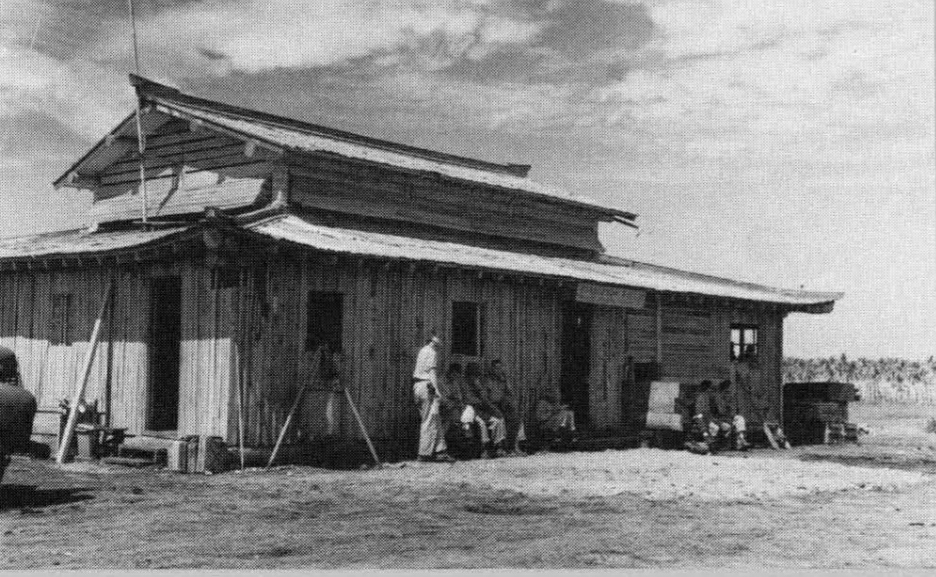
On 20 August, 19 planes of VMF-223 and 12 dive bombers of VMSB-232 were launched from the escort carrier Long Island and arrived safely at Henderson Field. The Marine pilots were quickly put into action over the skies of Guadalcanal in combat operations against enemy aircraft.
The men of CUB One performed heroics in servicing the newly arrived Marine fighters and bombers. Few tools existed or had yet arrived to perform many of the aircraft servicing jobs to which CUB One was assigned. It was necessary to fuel the Marine aircraft from 55-gallon drums of gasoline. As there were no fuel pumps on the island, the drums had to be man-handled and tipped into the wing tanks of the SBDs and the fuselage tanks of the F4F fighters. To do this, CUB One personnel stood precariously on the slippery wings of the aircraft and sloshed the gasoline from the heavy drums into the aircraft’s gas tanks. The men used a make-shift funnel made from palm-log lumber. Bomb carts or hoists were also at a premium during the early days of the Guadalcanal campaign, so aircraft bombs had to be raised by hand to the SBD drop brackets, as the exhausted, straining men wallowed in the mud beneath the airplanes. No automatic belting machines were available at this time as well, so that the .50-caliber ammunition for the four guns on each fighter had to be hand-belted one round at a time by the men of CUB One. The gunners on the dive bombers loaded their ammunition by the same laborious method.
The dedicated personnel of CUB One performed these feats for 12 days before Marine squadron ground crews arrived with the proper equipment to service the aircraft. The crucial support provided by CUB One was instrumental to the success of the “Cactus Air Force” on Guadalcanal. Like their Marine counterparts, the personnel of CUB One suffered from malaria, dengue fever, sleepless nights, and the ever-present shortage of food, clothing, and supplies. They would remain on Guadalcanal, performing their duties in an exemplary manner, until relieved on 5 February 1943. CUB One richly earned the Presidential Unit Citation awarded to the unit for its gallant participation in the Guadalcanal campaign.
—Arvil L. Jones with Robert V. Aquilina
Although this was probably taken much later at Guadalcanal, at 9:24 you can see how drums were unloaded…
 My Forgotten Hobby III